
Imagine matching with someone on Darlivo and realizing they live in a completely different culture, maybe even a different country.
Exciting, right?
But then you start talking and discover that the way you think about dating, relationships, family, communication, and even showing affection can be completely different.
That is what makes dating across Asia so interesting.
Asia is home to billions of people, hundreds of cultures, and countless traditions. There is no single definition of what dating looks like here. Dating in Japan can feel very different from dating in India. Dating in South Korea can be different from dating in Nepal, while dating in Thailand, the Philippines, or Singapore can have its own social expectations and traditions.
Yet underneath all those differences, there is something familiar.
People want to feel understood, respected, appreciated, and connected.
Modern dating apps are making it easier for people from different backgrounds to meet. Someone in Kathmandu can connect with someone in another city. Someone in Tokyo can meet someone who shares their love for food, music, travel, or movies. Two people from completely different backgrounds can start with nothing more than a simple message.
Through Darlivo, people can discover each other, share their everyday lives through Tinu Moments, and start conversations that may eventually become friendships, dates, or relationships.
So what does dating actually look like across Asia?
Let's explore it through a few simple love stories.
Dating in Asia Is Changing
Dating in Asia has changed significantly over the years.
Traditionally, relationships in many Asian societies were strongly influenced by family, community, religion, social expectations, and cultural traditions. In some places, dating was expected to lead toward marriage, while in others, romantic relationships were kept private for a long time.
Today, things are changing.
Young adults are meeting through universities, workplaces, social events, friends, social media, and dating apps. People are also becoming more comfortable deciding for themselves who they want to date and what kind of relationship they want. But traditional values have not disappeared. In many Asian cultures, family approval, respect, commitment, communication, and social expectations can still play an important role.
That combination of modern dating and traditional values is what makes dating culture in Asia so diverse.
Japan: Love Can Be Quiet and Subtle
Imagine Hiroshi and Aiko.
They matched on Darlivo after discovering that they both loved food and talking about everyday life. Their first conversations were simple. They talked about their favourite restaurants, weekend plans, movies, and the small things that happened during their day. Hiroshi noticed that Aiko rarely talked directly about her feelings.
Instead, she showed interest by remembering small details.
She remembered his favourite food.
She asked how his important meeting went.
She sent him a photo of a place she thought he would enjoy.
The relationship slowly developed through these small gestures.
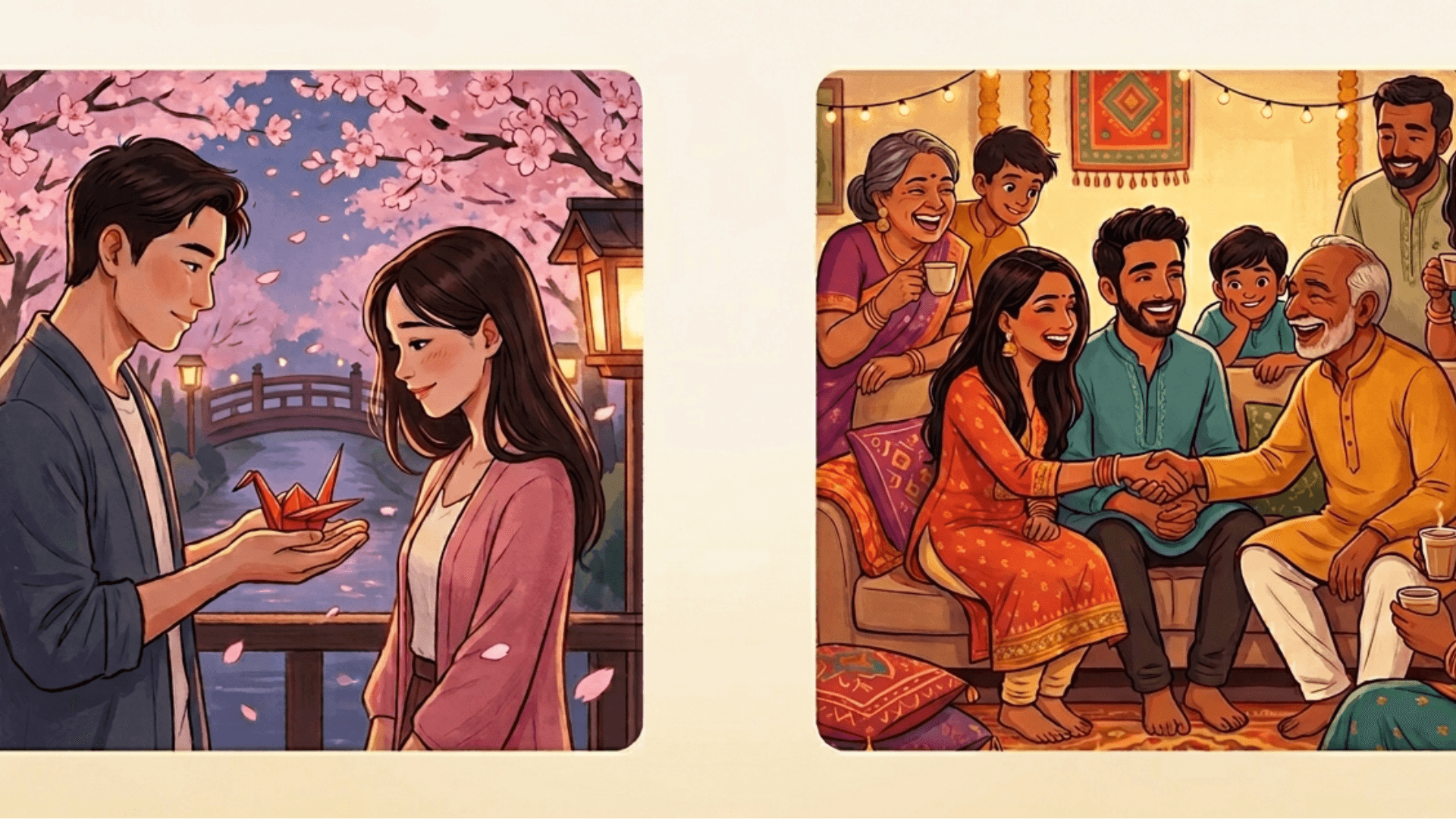
In Japan, communication in romantic relationships can sometimes be more subtle and less direct than people from some other cultures may expect. Rather than making dramatic declarations, affection can be shown through actions, consideration, and thoughtful gestures. So instead of planning an extravagant date, Hiroshi chooses something simple. A walk during cherry blossom season. They talk about their lives, laugh about old stories, and enjoy the evening together. Before saying goodbye, Hiroshi gives Aiko a small origami crane.
He takes a breath and quietly tells her that he has feelings for her.
No big drama.
No movie style proposal.
Just a small, meaningful moment.
And that is the beauty of cross cultural dating: sometimes you learn that affection does not always need to be loud. Sometimes, quiet actions can say a lot.
India: Love Can Include the Family
Now imagine Priya and Rahul.
They connected on Darlivo through their shared love for music, food, and humour.
Their conversations quickly became longer. They started talking every evening.
Soon, they wanted to meet. But Rahul knew that dating could involve more than just two people.
In many Indian families and communities, relationships can be closely connected to family expectations and traditions. The importance of family can vary greatly depending on the person, region, religion, and family, but for many people, family opinions can still influence relationships.
So instead of immediately planning a private romantic dinner, Rahul invites Priya to a family gathering. He introduces her as his Darlivo friend.
His family has questions.
Where is she from?
What does she do?
How did they meet?
What does she like?
The evening is full of food, laughter, curiosity, and a few slightly awkward questions.
Priya realizes that getting to know Rahul may also mean understanding the people who matter to him.This reflects one important part of dating in many Indian families: relationships can sometimes grow within a wider family and social environment.
But India is incredibly diverse.
Dating experiences in Mumbai may be different from those in Delhi, Kathmandu's neighbouring regions, Bengaluru, Kolkata, or smaller towns. Younger generations may have very different views from their parents.
That is why there is no single "Indian dating culture."
South Korea: Dating Can Be Thoughtful and Couple Focused
Now let's meet Min-jun and Soo-jin.
They met online and quickly discovered that they both loved Korean dramas, cafés, and late-night conversations. After chatting for several days, they planned their first date. They went to a small café, walked around the city, took photos, and ended the evening with dinner. For them, dating was not only about romantic conversations. It was about spending time together and creating shared experiences.
South Korean dating culture is often associated with couple activities, anniversaries, thoughtful gifts, and spending quality time together. Younger couples may also enjoy matching items, taking photos together, celebrating relationship milestones, or visiting popular date spots.
But, just like anywhere else, people are different.
Some prefer traditional dating.
Some prefer casual relationships.
Some want marriage.
Some are simply interested in meeting someone new.
A dating app gives people the opportunity to communicate those expectations before they decide how far they want the relationship to go.
Nepal: Dating Between Tradition and Modern Life
Meet Sagar and Anisha.
They live in the same city but never met through their usual social circles. One evening, Anisha opens Darlivo and discovers Sagar nearby. His profile catches her attention because they have similar interests. But what really starts the conversation is his Tinu Moment. He has posted about his favourite place to have momo.
Anisha reacts:
"Okay, serious question. Is this actually the best momo place in the city?"
Sagar replies.
The conversation starts.
In Nepal, dating is becoming more visible among younger generations, especially in cities. Social media and dating apps have created new ways for people to meet outside traditional social circles. At the same time, family expectations, cultural traditions, privacy, and social opinions can still influence relationships. For some people, dating is completely normal. For others, it may still be something they prefer to keep private. This is why online dating can feel useful for people who want to meet someone while taking their time to build trust and sometimes, the person you are looking for may be much closer than you think.
Thailand: Dating Can Feel Social and Relaxed
Thailand offers another interesting example of how dating can mix modern social life with cultural traditions.
Imagine Niran and Mali.
They meet through Darlivo and discover that they both enjoy exploring new places.
Their first few conversations are casual. They talk about food, travel, music, and their favourite places around the city. Instead of treating the first date like a formal interview, they decide to explore a local market together. They try different foods, take pictures, laugh about their terrible attempts at taking selfies, and slowly get comfortable around each other. For many people, dating is not necessarily about making a relationship decision immediately. Sometimes it is simply about spending time together and seeing whether there is a connection.
That idea is becoming increasingly common among younger people across Asia.
The Philippines: Communication Can Be a Big Part of Connection
Now consider Carlo and Mia.
They match online and quickly discover that they both love talking. Their first conversation lasts two hours then three. Eventually, they start sharing stories about their families, childhood memories, favourite music, and future plans. For them, communication becomes the foundation of the relationship. The Philippines has a strong culture of family and community, and relationships can be influenced by family values, religion, and social expectations. But younger Filipinos are also embracing modern ways of meeting people. Dating apps and social media can provide opportunities to connect with people outside one's immediate social circle and when two people from different backgrounds meet, communication becomes even more important.
You cannot assume that someone sees relationships the same way you do.
You have to ask.
You have to listen.
And sometimes, you have to learn.
Singapore: Modern Dating in a Multicultural Society
Singapore is a highly multicultural society where people from different ethnic, cultural, and religious backgrounds live and work together.
Imagine Daniel and Mei.
They meet on Darlivo and discover that they have different family traditions but surprisingly similar personalities. Their conversations quickly turn into discussions about food, festivals, work, travel, and family.
Dating becomes a way of learning about another person's background.
They may not celebrate the same festivals.
They may have different family expectations.
They may even speak different languages at home.
But they can still find common ground.
What About Dating Across Different Asian Cultures?
Now imagine something even more interesting.
You meet someone from another Asian country.
At first, everything feels easy.
You both like the same music.
You both love travelling.
You both enjoy trying new food.
You can talk for hours.
Then the cultural differences start appearing.
Maybe they communicate more indirectly.
Maybe you are very direct.
Maybe they expect family involvement sooner than you do.
Maybe you prefer taking things slowly.
Maybe they think meeting every day is normal.
Maybe you prefer seeing each other once or twice a week.
None of these differences automatically mean the relationship will fail.
They simply mean you have something to learn about each other.
Cultural Differences Can Actually Bring People Closer
Dating someone from a different culture can sometimes be challenging.
But it can also be exciting.
You may discover new food.
Learn new words.
Celebrate unfamiliar festivals.
Visit places you would never have considered.
Meet their friends and family.
Understand different traditions.
See relationships from a different perspective.
The important thing is curiosity.
Instead of saying:
"Why don't you do things like I do?"
Try asking:
"Is this normal in your culture?"
Communication Matters More Than Culture
Culture can influence dating, but it does not completely define a person. Two people from the same country can have completely different opinions about relationships. One person may want marriage. Another may want something casual.
One person may love constant communication. Another may prefer more personal space. One person may want their family involved early. Another may prefer keeping the relationship private. That is why you should never assume that someone's nationality tells you everything about them.
Ask the person.
Listen to them.
Learn what they believe.
That is how real connections develop.
Dating Apps Are Changing How Asians Meet
Technology has created a new chapter in Asian dating culture. People no longer have to depend entirely on school, work, family friends, or social circles to meet someone. A person can open an app and discover someone they would never have met otherwise. This is particularly interesting in Asia because of how many cultures and communities exist across the region. One conversation can cross borders. A person in Nepal can meet someone from another country. Someone in Japan can connect with someone interested in Japanese culture. Someone in India can meet a person outside their normal social circle. The possibilities are much wider than they were before. But the best part isn't simply meeting more people. It is finding someone you genuinely enjoy talking to.
How Darlivo Fits Into Modern Asian Dating
Darlivo is designed to make discovering and connecting with people feel more natural. Instead of focusing only on profile photos and endless swiping, Darlivo gives people different ways to show their personalities. One of those ways is Tinu Moments. A Moment might show someone's current mood, a place they visited, what they are eating, a thought they are having, or something they simply want to share. That gives other people something to respond to. And when people from different cultures meet, that can be especially useful.
A Moment can become an easy conversation starter.
"What food is that?"
"Where is this place?"
"Is that festival happening this week?"
"I've always wanted to visit your country."
"You like that artist too?"
A simple post can become the beginning of a conversation between two people who may never have met otherwise.
Why Tinu Moments Matter in Cross-Cultural Dating
Imagine matching with someone from another country. You want to message them.
But what do you say? This can be even harder when you are unfamiliar with someone's culture.
Tinu Moments can remove some of that awkwardness.
If they post about food, talk about food.
If they post about travel, ask about the place.
If they share a song, ask what they like about it.
If they post a question, answer it.
You don't have to immediately understand everything about someone. You can learn one small thing at a time and sometimes, that is how meaningful relationships begin.
Family Still Matters
One of the most interesting parts of dating in Asia is the role family can play. In some cultures and families, introducing a partner to parents can be a major relationship milestone. In others, couples may date privately for a long time before telling their families. Some families are very traditional. Others are extremely open minded. Some care strongly about religion, language, education, or background.
Others care mostly about whether their child is happy. Again, there is no single Asian experience. But if you are dating someone from a different cultural background, understanding their relationship with family can be important.
Ask questions.
What does family mean to them?
How involved are their parents?
What do they expect from a serious relationship?
Would they want their partner to participate in family traditions?
These conversations may not be exciting at first, but they can prevent misunderstandings later.
The Future of Dating Culture in Asia
Dating in Asia is likely to keep changing as technology, social attitudes, and lifestyles continue to evolve.
Dating apps have already made it easier for people to meet outside their usual social circles. Someone no longer has to depend only on school, work, family connections, or mutual friends to meet a potential partner. A simple profile, message, or shared interest can be the beginning of a new connection. But the future of dating is not only about technology. People are also becoming more comfortable talking about what they want from relationships. Some are looking for marriage and long term commitment. Others want to date casually, make new friends, or simply meet people with similar interests. At the same time, traditional values will continue to influence dating in many parts of Asia. Family, culture, religion, language, and social expectations may still play an important role in how people approach relationships. This means the future of Asian dating will probably be a combination of modern choices and traditional values. Technology may help people meet, but it cannot create genuine connection on its own. A match is only the beginning. Real connection comes from conversations, trust, respect, shared experiences, and understanding. Dating apps are also likely to become more focused on helping people show their personalities rather than relying only on photographs and short profiles. Features that allow people to share their interests, thoughts, activities, and everyday moments can make it easier to understand someone before meeting them. For people dating across different Asian cultures, this can be especially valuable. You may meet someone who speaks a different language, celebrates different festivals, has different family traditions, or approaches relationships differently. Instead of seeing those differences as barriers, dating can become an opportunity to learn about another person and another culture. The future of dating in Asia may therefore be less about finding the largest number of matches and more about finding meaningful connections.
The technology will continue to change. The way people meet will continue to change. But the basic things people look for in relationships are unlikely to change: someone who listens, understands, respects them, and makes them feel valued.
That is what makes dating exciting, no matter where in Asia you are.
Conclusion
There is no single definition of dating culture in Asia.
Dating in Japan may look different from dating in India. Dating in South Korea may be different from dating in Nepal, while Thailand, the Philippines, and Singapore each have their own social expectations and traditions. Yet beneath these differences, people often want the same basic things: connection, understanding, respect, trust, and companionship. Modern dating has created more opportunities for people to meet. Dating apps, social media, and online communities have made it possible to connect with people outside our usual circles and sometimes even across national borders. But meeting someone is only the first step. A successful relationship still depends on communication and understanding. When dating someone from another culture, it is important to stay curious instead of making assumptions. Ask questions. Listen to their experiences. Learn about their traditions. And remember that a person's culture is only one part of who they are. The most meaningful relationships are built when two people take the time to understand each other. Whether you meet someone through friends, at university, at work, while travelling, or through a dating app like Darlivo, the goal is ultimately the same: to find someone you genuinely enjoy connecting with. Because love may look different across Asia, but the desire to feel understood is universal. Different cultures. Different traditions. Different ways of dating. One simple idea finding a real connection.
FAQ: Dating Culture in Asia
Sure! Here are the answers in a short, simple, and SEO-friendly style:
1. What is dating culture in Asia?
Dating culture in Asia includes different traditions, values, and ways of dating across Asian countries.
2. Is dating common in Asian countries?
Yes. Dating is common, especially among younger people, but it can vary by culture and family values.
3. How is modern dating changing in Asia?
Dating apps, social media, and online communities are giving people new ways to meet and connect.
4. What role does family play in Asian dating?
Family can be very important, especially when relationships become serious, although this varies between families.
5. Is dating in Japan different from dating in India?
Yes. Dating styles and relationship expectations can be different in each country and culture.
6. What is dating like in Nepal?
Dating is becoming more common among young people, especially in cities, with dating apps creating new ways to meet.
7. Is online dating popular in Asia?
Yes. Dating apps are becoming an increasingly popular way to meet new people across Asia.
8. What is cross-cultural dating?
Cross-cultural dating means dating someone from a different cultural or national background.
9. What are the challenges of cross-cultural dating?
Different communication styles, family expectations, traditions, and relationship values can sometimes create challenges.
10. How can I date someone from a different culture?
Be respectful, ask questions, communicate openly, and take time to understand their culture.
11. Do Asian countries have similar dating traditions?
Not exactly. Each country, community, family, and individual can have different dating traditions.
12. Can dating apps help with cross-cultural dating?
Yes. Dating apps can help people meet and communicate with people from different backgrounds.
13. What should I talk about when dating someone from another culture?
Start with simple topics like hobbies, food, music, travel, movies, and everyday life.
14. Is there a “right” way to date in Asia?
No. Every person and culture can have different expectations about dating and relationships.
15. What is the most important thing to remember about dating culture in Asia?
Don't make assumptions. Get to know the person, communicate openly, and respect their background.